D-Mbs
1 2025-06-13T14:03:25+01:00 Maciek Zaweracz c26f9dd8134766e7ffbe916d9c070a81cc5f3c1f 9 1 Bayerische Staatsbibliothek, München plain 2025-06-13T14:03:25+01:00 Maciek Zaweracz c26f9dd8134766e7ffbe916d9c070a81cc5f3c1fThis page is referenced by:
-
1
2026-02-12T17:16:01+00:00
Compositions
26
Catalogue of original compositions by Carl Baermann
visual_path
4390
2026-03-20T08:39:12+00:00
Overview
Carl Baermann was an accomplished composer whose music was highly regarded and widely performed during his lifetime. The surviving works listed here consist primarily of music for clarinet and piano, and clarinet with orchestra. However, Baermann was also a prolific composer of vocal music: in a letter to Jähns in 1877, he refers to having composed 131 Lieder, of which 6 have been identified here. His correspondence also refers to a cello concerto, of which sadly only a sketched piano reduction has been identified; and an oboe concertino and other pieces for oboe, which are currently lost.
Dating
It is difficult to ascertain exact dates of composition for most of Baermann’s works. For works with distinctive titles, some indication can be gained from records of performances at the Munich court, but as the concert listings rarely include opus numbers, it is difficult to disambiguate those with generic titles. Baermann’s use of opus numbers when referring to works in correspondence is also infrequent, which is frustrating for identifying the pieces he is referring to and also raises the question of the point at which opus numbers were assigned. It is clear, however, that he did intend his opus numbers do relate to chronology of composition: in a letter to Schott's of 8 March 1842, Baermann writes: “I wish for the opus number to appear as I have written it on each manuscript, as they were assigned that way intentionally—to see whether the later compositions are better than the earlier ones”.
Publication dates, particularly for the works published by Schott’s, should not be taken to indicate period of composition, due to the often very long delay between Baermann supplying scores to his publishers and their being issued. The inclusion of a completion date of 2 July 1843 on the manuscript of the Introduction and Rondo op. 36 suggests that all of the preceding works date from prior to 1843. The composition of the Vollständige Clarinett-Schule opp. 63 and 64 from c. 1855–7 offers another point of reference, suggesting that Baermann’s works in the range op. 37–57 date from the mid-1840s to the early-1850s. This aligns with a reference in the programme for a court Abonnement-concert on 1 January 1847 to Baermann performing a Concertstück ‘zum Erstenmale’, likely a reference to either the Concertstück in D minor op. 44, or Concertstück in E flat major op. 49.
Missing works and unattributed opus numbers
Baermann kept a catalogue of his works, which he had to reconstruct after it became lost during a relocation, and which is non longer extant. His opus numbers range up to at least op. 88, of which 40 are currently accounted for: out of those 40, 30 are currently available in their entirety, with the remaining 10 excerpted in vol. V of the Vollständige Clarinett-Schule. The excerpted works are mostly concertos, as well as the Fantasie Orientale op. 22, Geisterstunde op. 29, and Elegie op. 55.
C. 1874 Baermann published a collection of four volumes containing 12 pieces for clarinet and piano, under the title Fantasiestücke und Lieder, op. 84–87. It is possible that these pieces, along with the many lost compositions for voice, may account for some of the unattributed opus numbers. He is also known to have re-worked pieces and assigned a new opus, as in the case of the Fantasie op. 7, reworked for two clarinets as the Duo Concertante op. 33. The other likelihood is that some of the 38 accompanied studies included in the Clarinett-Schule were originally pre-existing standalone compositions with their own opus numbers: this is supported by the inclusion of the opening section of Ein Traum op. 47 under the guise of etude no. 34 in volume II. Furthermore, when Baermann initially proposed the Clarinet–Schule to Schott’s in a letter of 29 April 1856, he referred to the second volume containing ‘about 70 to 80 specially composed exercises, and about three pieces with piano accompaniment’; yet by the time he approached André in November of the same year, it had taken the form of two studies in each key with piano accompaniment, a significant increase in the amount of material needed. While his correspondence with André in 1856–7 makes it clear he was creating much material specifically for the school, it remains a strong possibility that more of the etudes in vol. II were based on already-existing concert pieces.
Baermann and his publishers
Broadly speaking, Baermann’s earlier works published by B. Schott’s Söhnen in Mainz, his later works by Johan André in Offenbach-am-Main, and his editions by Robert Lineau in Berlin. Baermann’s side of his correspondance with Schott’s and André reveals much about his working practices, his relationship with both publishers and his wishes for the publications of his works.
Though Baermann’s father had had some correspondence with Schott’s in the 1830s, Baermann’ relationship with them appears to have been instigated by their approaching his colleague Joseph Faubel c. 1841, after Faubel performed one of Baermann’s works. Baermann responded to their Schott’s interest by offering them a range of smaller and larger works, many of which were gradually published over the subsequent years (letter of 3 June 1841). Baermann’s letters also reveal his concern over the details of his scores, and in particular the wording of their title pages and dedications. Baermann’s letters showing him trying to maintain a good relationship with the firm despite the apparent laxity of Schott’s operations: he complains at various points that proof copies were riddled with errors, that dedications were left off title pages (causing him some embarrassment), and that he was not supplied with copies of his published works or even notified that they had come out. The delays between manuscripts being supplied and being published are also notable, amounting to years at a time: a situation that essentially held Baermann hostage, as he evidently did not routinely keep his own copies of works supplied to the publisher.
Despite these issues, and receiving offers from publishing houses in Vienna and Leipzig, Baermann remained loyal to Schott's until 1856, even offering them the opportunity to publish his Clarinett-Schule. However, later the same year, he apparently finally gave up, approaching the firm of Johan André instead with the project, citing his ‘unpleasant experiences’ with his former publisher (letter of 22 November 1856). Though Schott's continued issuing the works that Baermann had previously supplied to them well into the 1870s, his later compositions were published by André, who also published his editions of Mozart’s Concerto k. 622 and Quintet k. 581. Baermann’s relationship with André appears to have been a more positive one, as he continued publishing with them until the mid-1870s.
At some point in the 1870s, Baermann began working with a third publisher, Robert Lineau. Lineau had taken over Schlesinger, the house that had published the works of Weber, and it is probably this existing connection that led to Baermann’s own editions of Weber’s clarinet works were issued by the firm. No correspondence between Lineau and Baermann has so far been traced, so it is unknown who approached whom with the project. Baermann's correspondence with the Weber scholar Friedrich Wilhelm Jähns shows that Jähns often acted as a go-between and thus may have been involved in brokering the relationship. In an 1872 letter to Jähns, Baermann also refers to offering Lineau the scores clarinet pieces, his cello concerto and some of his songs, presumably in an effort to get them issued by the firm. In his letter to Jähns of 22 November 1877, Baermann reports that following the loss of his catalogue of works, he can no longer recall which songs were given to Lineau, and wants to avoid offering the same ones to another publisher by mistake, indicating that as late as 1877, he was still hoping to have more of them issued and presumably seeking a relationship with a new publishing house.
A final reference in Baermann’s penultimate letter to Jähns of 16 June 1879 is somewhat of a conundrum: Baermann excuses his tardy reply, saying ‘your letter threw me into such a turmoil of musical work, as I had to prepare 9 pieces of music for the engraving’. It is unclear what the other scores might have been, and what role Jähns had in the process, though his involvement might indicate that Baermann was preparing publications for Lineau. However, the Hofmeister Monatsberichte does not list any new issues under Baermann’s name after June 1880.
Sources and information
The sources and information presented here draw on the database and holdings of the Schott-Archiv, the database of Répertoire Internationale des Sources Musicales (RISM), the Hofmeister Monatsberichte as represented by the Hofmeister XIX database, and the holdings of the Staatsbibliothek Berlin (D-B) and Bayerische Staatsbibliothek (D-Mbs), as well as other major libraries and collections. Digitised versions of manuscript and print sources are embedded or linked where available. The Schott-Archiv contains many of Baermann’s autograph manuscripts, which also acted as Stichvorlage or basis for engraving; Druckbücher, that is Schott’s own records of printing; and examples of the editions issued (n.b. many of those digitised appear to be later reprints with late-19th or early-20th century title pages). The archive of the André publishing firm is still held privately by the company and there are no public finding aids beyond the catalogue of publications, and it has not yet been possible to consult the holdings; however, letters from Baermann to André relating to the publication of the Vollständige Clarinett-Schule were previously transcribed in Erdt. The Schlesinger-Verlagsarchiv containing publishing catalogues and correspondence of Robert Lineau was acquired by the Staatsbibliothek Berlin in September 2024. It has not yet been ascertained whether it contains holdings relating to Baermann.
For each work, the autograph sources are listed, alongside details of the publications instigated by Baermann. Where there is a discrepancy between the titles in the autograph and print sources, the published version is given. Publication dates are based on the Schott's Druckbücher for Schott's publications, plate numbers for André publications, and the Hofmeister Monatsberichte. Modern editions of Baermann’s works have not been included: for this information, please see the index of works prepared by Hill.
The following works are referred to in letters and other sources but not otherwise traced:
- A concertino for Oboe and further pieces for oboe (letters from Baermann to B. Schott's Sohne, of 3 June 1841 and 10 May 1844)
- c. 125 further songs, in addition to the six currently identified
- Three further concertos, listed in Baermann’s 1874 syllabus for his class at the Munich Hochschule, in addition to those accounted for in extant sources: a Concerto in F minor; a second Concerto in B flat, in addition to op. 48; and third Concerto in E flat, in addition to op. 26/62 and op. 60, which may however be a reference to the E flat major Concertstück op. 49.
The following works are erroneously listed in other sources:
- Bassoon Concerto op. 1: Listed on IMSLP, but clearly the work of Baermann’s uncle, the Prussian bassoonist Carl Baermann
- Air Varié op. 12: Listed in Erdt, probably a mistaken reference to Heinrich Baermann’s Trois Airs Variés op. 12, published by Gambaro and Simrock
- La Nuit Etoilée op. 13: Listed on IMSLP, an erroneous reference to op. 17
- Quartet op. 18: Referenced in Weston, likely a mistaken reference to Heinrich Baermann’s Quartet op. 18
- Concerto in E flat op. 23: listed in Erdt, likely a mistaken reference to Heinrich Baermann’s Concerto op. 23
- Concerto in E flat op. 26 and op. 62: excerpts from these works are given sequentially in Clarinett-Schule vol. V. Given the similarity of the material they are evidently the same piece, with one of the opus numbers being a misprint of the other.
-
1
2026-02-12T17:22:11+00:00
Divertissement, op. 2
21
Work overview and sources
plain
2026-03-30T09:21:59+01:00
Composer Baermann, Carl
Work title Divertissement in A flat, op. 2
Scoring cl, pno; cl, vl (2), vla, vlc, cb, fl (2), ob (2), cl (2), fag (2), cor (2), tr (2), timp
Composition date pre-1844
Manuscript sources D-Mbs Mus.Schott.Ha 7770-2 (full score) ; Mus.Schott.Ha 7771-2 (piano reduction); MS copy in HR-Bjm VI-60
Printed editions Schott 7578 (1844): D-Mbs Mus.Schott.Ha 7770-1 (orchestral parts) ; Mus.Schott.Ha 7771-1 (piano reduction)
Dedication 'Herzog Maximilian in Bayern': Duke Maximilian Joseph in Bavaria (1808–1888)
-
1
2026-02-12T16:28:03+00:00
Militär-Conzert, op. 6
13
Work overview and sources
plain
2026-03-30T09:37:52+01:00
Composer Baermann, Carl
Work title Militär-Conzert, op. 6
Scoring cl, pno; cl, vl (2), vla, vlc, cb, fl (2), ob (2), cl (2), fag (2), cor (2), tr (2), ba (2), timp
Composition date c. 1837 based on reviews and concert listings
Manuscript sources D-B Mus.ms. 1010 (orchestral score, MS presentation copy c. 1871); further copy in B-Bc.
Printed editions Schott 21680 (1875) in D-Mbs 4 Mus.pr. 44857 (piano reduction); Full score ed. M. van den Berg (2021) on IMSLP
Dedication The manuscript score appears to be a presentation copy with the inscription 'Seiner Majestät / Kaiser von Deutschland und König von Preußen / Wilhelm I / in tiefster Ehrfurcht gewidmet'. Wilhelm was King of Prussia from 1861 and German Kaiser from 1871. In a letter to Schott of 1 June 1861, Baermann requests a dedication to 'Mr. Th[omas] Klein, imperial-royal chamber musician and 1st clarinetist of the imperial-royal theater at Kärntnertor in Vienna'.
Notes no manuscript sources in Schott-Archiv despite frequent mentions of it in the correspondence.
-
1
2026-02-12T16:24:55+00:00
Fantaisie Brilliant, op. 7
11
Work overview and sources
plain
2026-03-30T09:22:43+01:00
Composer Baermann, Carl
Work title Fantaisie Brilliant, op. 7
Scoring cl, pno
Composition date pre-1843
Manuscript sources D-Mbs Mus.Schott.Ha 6955-2 (piano score); Mus.Schott.Ha 12265-5 (fragment)
Printed editions Schott 6880 (1843) in D-Mbs Mus.Schott.Ha 6954 (piano score);
-
1
2026-02-13T09:04:43+00:00
Sternenhelle Nacht (ein Fantasie-Gebilde), op. 17
10
Work overview and sources
plain
2026-03-30T09:24:35+01:00
Composer Baermann, Carl
Work title Sternenhelle Nacht (ein Fantasie-Gebilde) / Une nuit étoilée: morceau de fantaisie, op. 17
Scoring cl, pno
Composition date pre-1843
Manuscript sources D-Mbs Mus.Schott.Ha 6955-2
Printed editions Schott 6882 (1843) in D-Mbs Mus.Schott.Ha 6956
-
1
2026-02-12T16:35:18+00:00
Variations Brilliantes, op. 8
10
Work overview and sources
plain
2026-03-30T09:11:07+01:00
Composer Baermann, Carl
Work title Variations Brilliantes, op. 8
Scoring cl, pno; cl, orch
Composition date pre-1846
Manuscript sources D-Mbs Mus.Schott.Ha 7772-2 (full score)
Printed editions Schott 7579 (1846) in D-Mbs Mus.Schott.Ha 7772-1 (piano score)
Dedication Freidrich Sendelbeck (d. 1890), principal horn in the Bayerische Hofkapelle
-
1
2026-02-12T16:41:46+00:00
Die kleine Bettlerin, op. 14
9
Work overview and sources
plain
2026-03-30T09:23:13+01:00
Composer Baermann, Carl
Work title Die kleine Bettlerin, ein Gesangs-Scene, op. 14
Scoring cl, pno
Composition date c. 1838
Manuscript sources D-Mbs Mus.Schott.Ha 6955-2 (piano score) and D-Mbs Mus. Schott. Ha 8075 (alternative cello part)
Printed editions Schott 6881 (1844) in D-Mbs Mus.Schott.Ha 6955-1 (clarinet and piano)
Notes Catalogued erroneously as "Die kleinste Bettlerin" in D-Mbs/Schott-Archiv
-
1
2026-02-12T17:02:20+00:00
Fantasie, op. 15
8
Work overview and sources
plain
2026-03-30T09:10:20+01:00
Composer Baermann, Carl
Work title Fantasie, op.15
Scoring cl, pno; cl, orch
Composition date
Manuscript sources D-Mbs Mus.Schott.Ha 12265-3 (piano score); Mus.Schott.Ha 12265-4 (orchestral score)
Printed editions Schott 11436 (1872); D-Mbs Mus.Schott.Ha 12265-1 (piano score and part); Mus-Schott.Ha 12265-2 (orchestral parts)
Dedication Heinrich Venzl (d. 1889), 1st clarinet in the königliche bayerische Hofkapelle
Notes Venzl joined the Hofkapelle in 1865.
-
1
2026-02-15T10:30:17+00:00
Souvenirs de Bellini, op. 52
6
Work overview and sources
plain
2026-03-30T10:17:50+01:00
Composer Baermann, Carl
Work title Souvenirs de Bellini: Fantaisie Brilliante, op. 52
Scoring cl, pno; cl, orch
Composition date 1846
Manuscript sources D-Mbs Mus.Schott.Ha 12267-3 (piano score); Mus.Schott.Ha 12267-4 (full score); Mus.Schott.Ha 12267-5 (orchestral parts)
Printed editions Schott 11438 (c. 1873) in D-Mbs Mus.Schott.Ha 12267-1 (piano score add part); Mus.Schott.Ha 12267-2 (orchestral parts)
Dedication 'Seiner verehrtem Frende Herrn Heinrich Mösler Mitglied des städt Theater-Orchesters in Cöln'
Notes Printed edition includes breath/phrasing marks and rubato indications, -
1
2025-06-13T14:03:08+01:00
Heinrich Baermann to B. Schott's Söhne, 1836
5
Letter details
plain
2026-03-02T21:36:15+00:00
48.13516553187103, 11.582059693584066
1836
B. Schott's Söhne
Heinrich Baermann
From Heinrich Baermann, München, 1836
To B. Schott's Söhne
Source D-Mbs, Ana 800.A.IV. Bärmann, Heinrich Joseph. See Schott-Archiv.
No digitisation or transcript currently available. Please see source record for further details. -
1
2026-02-12T17:44:14+00:00
Duo in F, op. 4
5
Work overview and sources
plain
2026-03-30T09:12:15+01:00
Composer Baermann, Carl
Work title Duo [Concertant] in F, op. 4
Scoring cl in Bb, pf
Composition date pre-1843
Manuscript sources D-Mbs Mus.Schott.Ha 6955-2
Printed editions Schott 6879 (1843); D-Mbs Mus.Schott.Ha 6953
-
1
2026-02-15T10:49:36+00:00
Concertstück no. 1, op. 49
5
Work overview and sources
plain
2026-03-30T10:07:45+01:00
Composer Baermann, Carl
Work title Concertstück [Konzertstück] in E flat no. 1, op. 49
Scoring cl, orch; cl, pno
Composition date
Manuscript sources D-Mbs Mus.ms. 9204
Printed editions Johan André, Offenbach-am-Main, no. 12355 (c. 1880) (piano reduction), in D-B DMS 30906
Dedication [MS] 'Seiner Excellenz dem General-Intendant der königl. Schauspiele und der königl. Hof. Herr Carl Freiherr von Perfall' -
1
2026-02-15T10:14:29+00:00
Melodische Schwärmereien, op. 53
4
Work overview and sources
plain
2026-03-30T10:25:12+01:00
Composer Baermann, Carl
Work title Melodische Schwärmereien: solo fantastique mit Pianoforte-Begleitung, Op. 53
Scoring cl, pno
Composition date pre-1848
Manuscript sources D-Mbs Mus.Schott.Ha 12268-2
Printed editions Schott 11439 (1854) in D-Mbs Mus.Schott.Ha 12268-1
Dedication 'Seinem Freunde H. Schunke gewidmet' -
1
2025-06-13T14:03:30+01:00
Theaterzettel des Hof- und Nationaltheater
4
Overview of digitised theatre bills and concert programmes in D-Mbs
plain
2025-06-25T12:02:11+01:00
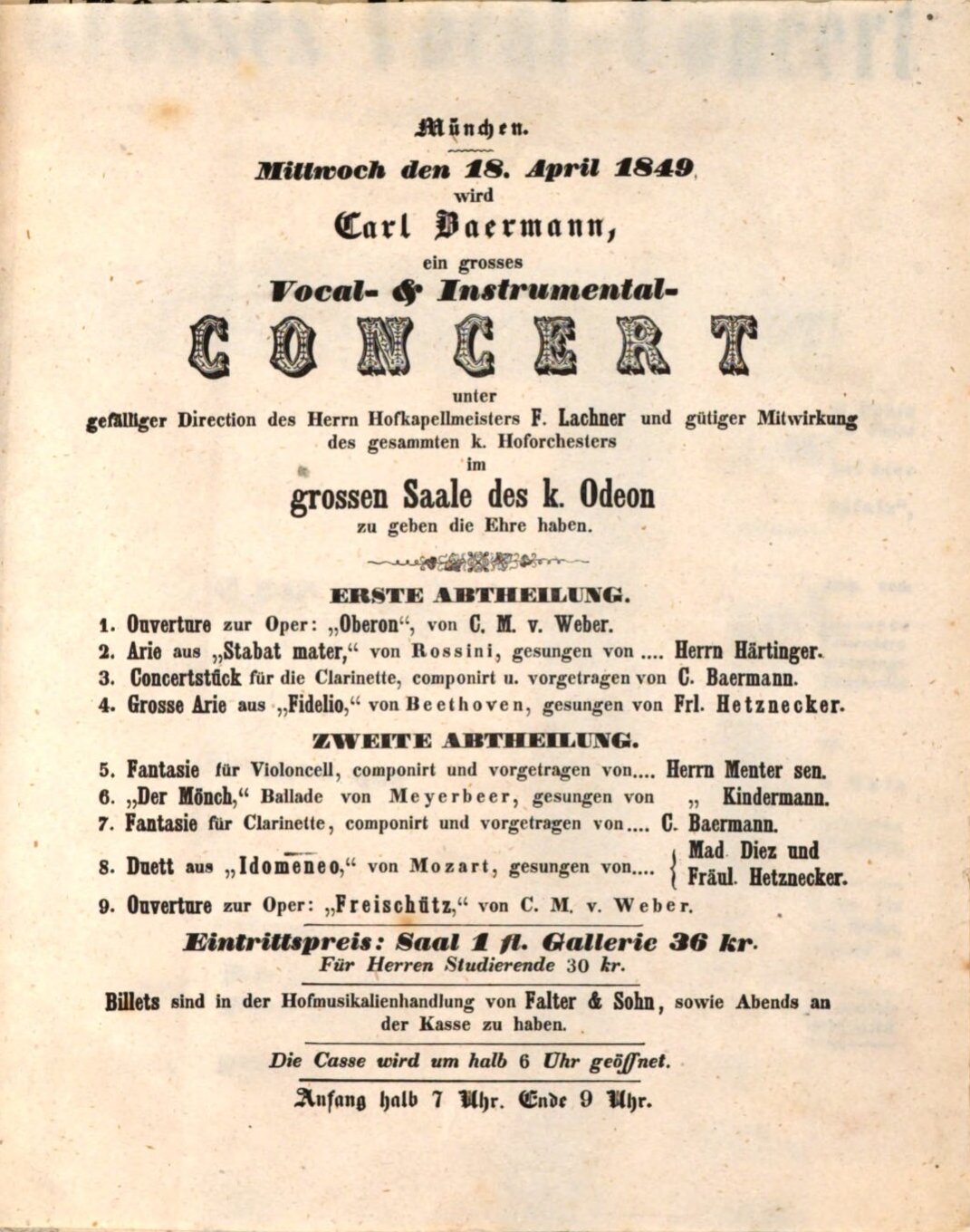
D-Mbs has digitised playbills of the Königliches Hof- und Nationaltheater in its holdings between 1805–1918. The volumes include both stage productions and concerts, though coverage is not comprehensive and from 1865 the volumes appear to only contain stage productions.
Carl Baermann appears regularly as a performer in various contexts, including miscellaneous 'Vocal- und Instrumental-Concert[e]', usually given for the benefit of a specific musician, and the subscription series given by members of the Hofkapelle under various names such as 'abonnirtes Konzert', 'Concert der Mitgleider der Königliche Hofkapelle' and 'Abonnement-Concert'. In these concerts, In these concerts, Baermann performed almost exclusively his own compositions, though chamber works by Beethoven, Hummel, and Mozart do begin to feature occasionally from the mid-1840s. Baermann's works were also performed by other clarinetists, most often his Hofkapelle colleague Faubel at the long-running 'musikalische-declamatorische Abendunterhaltung[en]'.
The digitisations are OCR-searchable, but variant spellings need to be included (for instance 'declamatorische' and 'deklamatorische').
A full list of the holdings and links to digitised volumes can be accessed here. -
1
2026-02-16T08:01:06+00:00
Ein Traum, op. 47
4
Work overview and sources
plain
2026-03-30T10:09:13+01:00
Composer Baermann, Carl
Work title Ein Traum: Divertimento für Clarinette, op. 47
Scoring cl, pno
Composition date pre-1840
Manuscript sources
Printed editions Andre 7898 (c. 1857) in D-Mbs 2 Mus.pr. 1060 (2 digitisations)
Notes Opus number is not present on André edition. Opening section (prior to theme) is identical to the Etude no. 34 in vol. II of the Vollständige Clarinet-Schule. -
1
2025-06-13T14:03:08+01:00
Heinrich Baermann to B. Schott's Söhne, 1835
3
Letter details
plain
2026-03-02T21:37:19+00:00
48.13516553187103, 11.582059693584066
1835
B. Schott's Söhne
Heinrich Baermann
From Heinrich Baermann, München, 1835
To B. Schott's Söhne
Source D-Mbs, Ana 800.A.III. Bärmann, Heinrich Joseph
No digitisation or transcript currently available. Please see source record for further details. -
1
2026-02-15T11:10:13+00:00
Ein Abend auf den Bergen, op. 25
3
Work overview and sources
plain
2026-03-30T09:29:31+01:00
Composer Baermann, Carl
Work title Ein Abend auf den Bergen / Une Soirée sur les Montagnes, op. 25
Scoring cl, pno
Composition date [c. 1842]
Manuscript sources D-Mbs Mus.Schott.Ha 8387-2
Printed editions Schott 8131 (1846), in D-Mbs Mus.Schott.Ha 8387-1
Dedication Baermann's correspondence with Schott's indicates an intention to dedicate the piece to Friedrich Wilhelm IV of Prussia -
1
2026-02-16T08:53:46+00:00
Introduction and Rondo, op. 36
3
Work overview and sources
plain
2026-03-30T09:43:52+01:00
Composer Baermann, Carl
Work title Introduction and Rondo für die Clarinette in B mit großen Orchester, op. 36
Scoring cl, orch
Composition date
Manuscript sources D-Mbs Mus.ms. 9205
Printed editions Offenbach-am-Main: Johan André no. 11421 (c. 1873) (piano reduction), in D-B DMS 30899
Notes Score and parts edited by Marnix van den Berg (2022) available on IMSLP. -
1
2025-06-13T14:03:25+01:00
Weber: Concerto No. 1 in F minor, op. 73
3
Sources and editions
plain
2026-02-12T16:11:31+00:00
Composer
Carl Maria von Weber
Work title
Clarinet Concerto No. 1 in F minor, op. 73
Composition date
1811
Selected manuscript sources
Autograph score from Weber's private library in D-B ms. autogr. C. M. v. Weber WFN 11.
Autograph copy in Weber's hand, previously owned and used by Heinrich and Carl Baermann, in US-Wc ML30.8b .W4 (see below). This score contains various annotations and alterations, including the insertion of the 16-bar 'Baermann cadenza' in the first movement.
A number of annotations added and subsequently deleted from US-Wc do not have parallels in the later Baermann edition. These likely reflect the ongoing development of the Baermann's performance practices as well as what information they felt needed to be conveyed to the orchestra in rehearsal and performance. The following is based solely on examination of the digitised score; an in-person inspection may yield more information.
I b. 47: [pause symbol]
I b. 96: 'ritard'
I b. 278 indications to slow down: both Weber's hand and subsequent annotations have been excised
II 18–20: alternating Forte and Piano markings on each phrase.
III b. 124: 'poco meno'
III b. 282: 'Tempo I'
III b. 332: 'piu allegro'
Early prints
First edition, supervised by Weber: Schlesinger pl. 1177 (1824), piano version digitised by D-Mbs 4 Mus.pr. 89.717.
Carl Baermann edition
Robert Lineau/Schlesinger, pl. S. 1177 (1870). Available commercially as part of the Henle Urtext edition (see below), and as Lineau RL36270.
Significant additions and alterations to all aspects of the music, including the inclusion of the 16-bar 'Baermann cadenza' in the 1st movement, as well as metronome marks for movements and sections.
Metronome marks:
I Allegro: crotchet = 108
b. 110 con anima: 'Tempo ritenuto' crotchet = 92
b. 130 lusingando e con espressione: 'Con moto': crotchet = 100
b. 145: 'Tempo I': crotchet = 112
b. 170: 'Un poco ritenuto': crotchet = 92
b. 192: grazioso: 'Tempo I': crotchet = 100
II Adagio ma non troppo crotchet = 46
b. 31 Poco più animato: crotchet = 66
III 'Allegro' [Weber: Allegretto]: crotchet = 120
Modern critical editions
Henle 731, edited by Norbert Gertsch. Henle (2002). Urtext version based on the MS sources and first edition, alongside Baermann's edition.
Weber Sämtliche Werke V Bd. 6., Schott WGA 1056 (2010), edited by Frank Heidlberger. Also available as Schott KLB 78 (piano reduction, first edition version only) and Eulenberg ETP 1902 (miniature score with parallel clarinet parts).
Notes
See prefaces and critical commentaries to the urtexts by Gertsch (2002) and Heidlberger (2010) for further information.Explore further sources in the Virtual Archive relating to Baermann's edition of this work by following the path below.
-
1
2026-02-12T12:46:46+00:00
Mendelssohn: Konzertstück No.2 , Op.114
3
Sources and Editions
plain
2026-02-12T16:12:45+00:00
Composer
Felix Mendelssohn
Work title
Konzertstück [Concertstück] No.2, Op.114
Composition date
1833
Selected manuscript sources
Autograph piano version held in S-Smf MS 926 (not digitised).
Manuscript of orchestral version in unknown hand, arrangement attributed to Carl Baermann, available at D-Mbs Mus.ms. 2353.
Carl Baermann edition
André pl. 10056 (c. 1869). Available at D-Dl Mus.5543.Q.501-1
Baermann's edition of the piano version is the first published version of the work. It contains extensive additional dynamics, articulations, and expression markings as well as metronome marks and expanded cadenzas for both instruments in the introduction.
Metronome marks:
Presto: minim = 116
Andante: quaver = 88
Allegro gracioso: crotchet = 108
Modern critical editions
Henle 1067, edited by Frank Heidelberger (2015). Urtext version based on autograph piano and orchestral versions.
Notes
See prefaces and critical commentary to the edition by Heidlberger (2015) for further information. -
1
2026-02-15T11:19:32+00:00
Verlornes Glück, op. 30
2
Work overview and sources
plain
2026-03-30T09:32:05+01:00
Composer Baermann, Carl
Work title Verlornes Glück: Lied für die Clarinette, / Le bonheur perdu, op. 30
Scoring cl, pno
Composition date
Manuscript sources D-Mbs Mus.Schott.Ha 12266-2 (piano score); Mus.Schott.As 771 (arr. for cello and piano)
Printed editions Schott 11437 (1853) in D-Mbs Mus.Schott.Ha 12266-1
Dedication Joseph Vizthum, 1st oboist in the königliche bayerische Hofkapelle -
1
2025-06-13T14:03:18+01:00
Weber: Grand duo concertant, op. 48
2
Sources and editions
plain
2026-02-12T16:11:04+00:00
Composer
Carl Maria von Weber
Work title
Grand duo concertant, op. 48
Composition date
1815–16
Selected manuscript sources
Autograph sketches in D-B
Autograph fair copy is digitised in US-Wc. According to Allroggen and Holsträter, these were made by Weber for his own archive, and do not derive from same source as D-B.
Engraver’s proof is in A-Wst.
Early prints
First edition, Schlesinger pl. 253 (1817), digitised by D-Mbs (see below)
Carl Baermann edition
Robert Lineau pl. S. 5590 (1869). Commercially available as RL36080. Comparative clarinet part forthcoming.
Baermann's edition features extensive changes to phrasing and articulation, additional and changed dynamics, additional tempo and expression indications, and metronome marks in the first and second movements. He also adds rehearsal letters.
Notably, Baermann's changes to the phrasing marks tend towards replacing Weber's unusually long slurs with shorter ones, or removing them entirely, creating a more articulated and less legato effect overall.
Metronome marks:
Allegro con fuoco: minim = 116
Andante con moto: crotchet = 48
Rondo Allegro: no mark
Modern editions
Weber Sämtliche Werke VI Bd. 3., Schott WGA 1063 (2005), edited by Gerhard Allroggen and Knut Holsträter. Also published as Schott KLB 58. Gives priority to the engraver's proof (A-Wst).
Notes
For further sources, see the Weber Gesamtasugabe. -
1
2025-06-13T14:03:24+01:00
References
2
plain
2026-03-20T07:49:05+00:00
Primary Sources: Holding Institutions and Collections
CH-SGv Kantonsbibliothek Vadiana, St. Gallen
D-B Staatsbibliothek zu Berlin - Preußischer Kulturbesitz, Musikabteilung, Berlin
D-Bim Staatliches Institut für Musikforschung - Preußischer Kulturbesitz, Berlin
D-Dl Sächsische Landesbibliothek - Staats- und Universitätsbibliothek, Dresden
D-Heu Universitätsbibliothek, Heidelberg
D-Hs Staats- und Universitätsbibliothek Carl von Ossietzky, Musiksammlung, Theatersammlung, Hamburg
D-Hth Universität Hamburg, Zentrum für Theaterforschung, Theatersammlung, Hamburg
D-KA Badische Landesbibliothek, Karlsruhe
D-LEsm Stadtgeschichtliches Museum, Bibliothek, Leipzig
D-Mbs Bayerische Staatsbibliothek, München
GB-Lbl The British Library, London
GB-Ob Bodleian Library, Oxford
US-NYpm Pierpont Morgan Library, New York
US-Wc Library of Congress, Washington, D.C.Secondary Sources
Erdt, Robert. Der Münchner Klarinettenvirtuose Carl Baermann als Pädagoge, Klarinettist und Komponist. Frankfurt am Main: Peter Lang, 2009
Mendelssohn-Bartholdy, Felix, et al. Sämtliche Briefe. Kassel: Bärenreiter, 2008
Meyerbeer, Giacomo. Briefwechsel und Tagebücher. Edited by Heinz Becker. Berlin: Walter de Gruyter, 1959-2006
Nohl, Ludwig, ed. Musiker-Briefe: eine Sammlung Briefe von C.W. von Gluck, Ph. E. Bach, Jos. Haydn, Carl Maria von Weber und Felix Mendelssohn-Bartholdy. Leipzig: Duncker und Humblot, 1867.
Poissl, Johann Nepomuk von. Briefe (1807-1855): ein Blick auf die Münchener Musik- und Theatergeschichte. Edited by Volkmar von Pechstaedt. Göttingen: Hainholz, 2006
Weston, Pamela. Clarinet Virtuosi of the Past. London: Robert Hale, 1971.Online databases
Hofmeister XIX -
1
2025-06-13T14:03:20+01:00
Heinrich Baermann to Kunstverein/Scheidsgericht München
1
Letter details
plain
2025-06-13T14:03:20+01:00
48.13516553187103, 11.582059693584066
Kunstverein (München)
Heinrich Baermann
From Heinrich Baermann, München
To Kunstverein München
Source D-Mbs. See Kalliope.
Notes Addressed to the arbitration court of the Kunstverein.
No digitisation or transcript currently available. Please see source record for further details. -
1
2025-06-13T14:03:20+01:00
Heinrich Baermann to unknown
1
Letter details
plain
2025-06-13T14:03:20+01:00
Unbekannt
Heinrich Baermann
From Heinrich Baermann
To Unknown
Source D-Mbs. See Kalliope.
No digitisation or transcript currently available. Please see source record for further details. -
1
2025-06-13T14:03:07+01:00
Louis Spohr to Heinrich Baermann, 2 August 1826
1
Letter details with summary and link to online transcription
plain
2025-06-13T14:03:07+01:00
51.31421341461195, 9.483958010408095
2 August 1826
Heinrich Baermann
Louis Spohr
From Louis Spohr, Kassel, 2 August 1826
To Heinrich Baermann
Source D-Mbs
Transcription Spohr-Briefe (see below)
Summary Spohr thanks Baermann for news of the success of his opera Faust in Munich and expresses the wish to hear it performed by the Munich orchestra, which he esteems. Spohr asks that von Poißl be informed in return that his opera die Prinzessin von Provence was received favourably in Kassel, and suggests that his own relationship with Poißl seems to have deteriorated.
.jpg)



.png)